

As Part of Field Visits to Industrial Strongholds, Minister of Industry Begins Tour in Al-Mahalla Al-Kubra by Inspecting Factory Complex of Misr Spinning and Weaving Company
Eng. Khaled Hashem:
- Misr Spinning and Weaving Company represents backbone of national textile industry and main pillar of comprehensive modernization system witnessed by Egyptian textile sector
- MSWC encompasses spinning, weaving, dyeing, finishing, and ready-made garment factories, making it integrated industrial landmark
- Integration across the value chain at MSWC supplies essential production inputs, reducing import reliance and maximizing the added value of Egyptian long-staple cotton
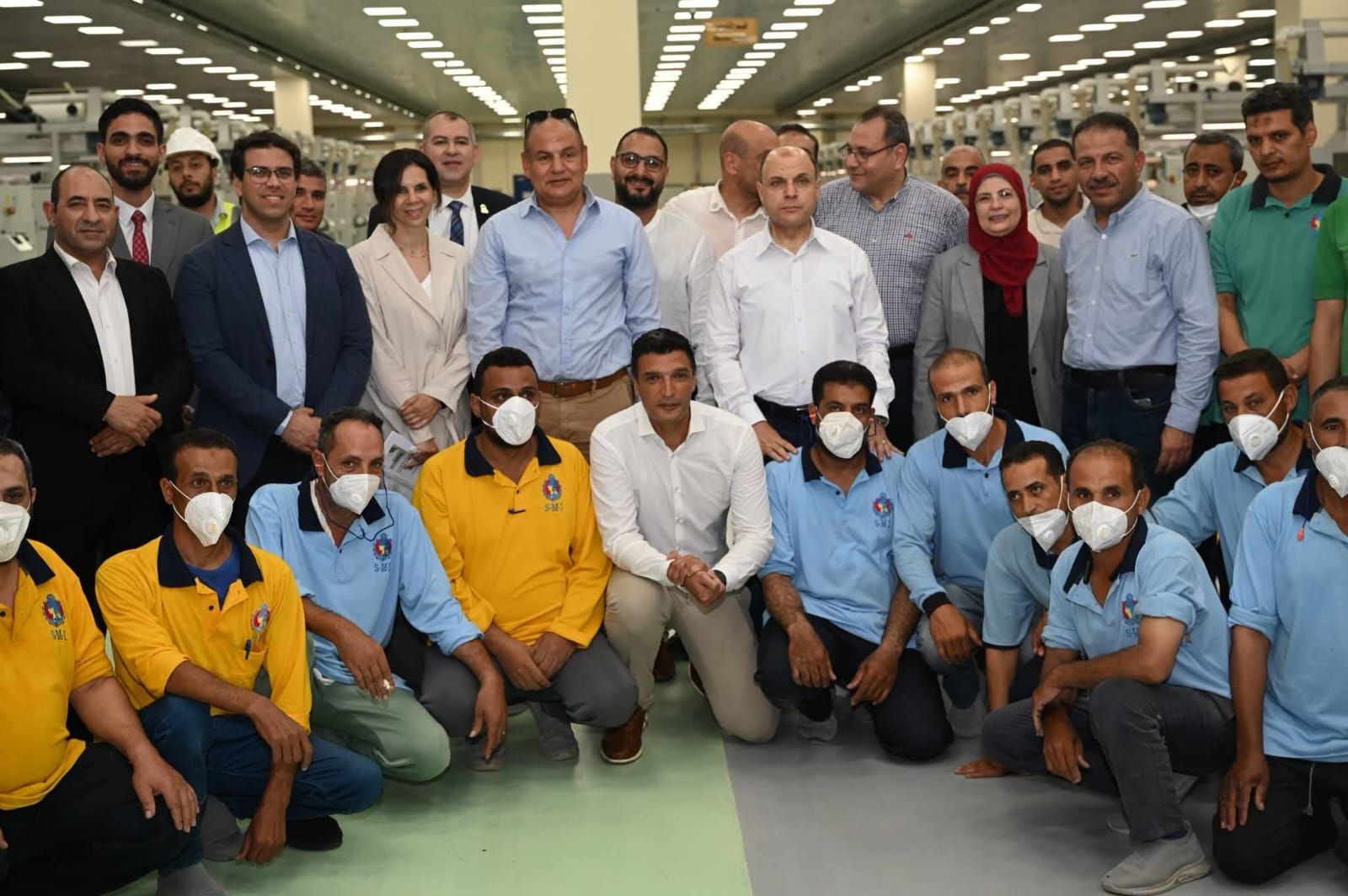
As part of series of field visits to industrial strongholds across Egypt, Eng. Khaled Hashem, Minister of Industry, initiated today's visit to Al-Mahalla Al-Kubra City by inspecting factory complex of Misr Spinning and Weaving Company (MSWC). The minister was accompanied during the tour by Maj. Gen. Dr. Alaa Abd El-Moaty, Governor of Gharbia, Dr. Nahed Youssef, Chairperson of Industrial Development Authority (IDA), Maj. Gen. Ihab Amin, Chairman of Industrial Control Authority (ICA), Ms. Maha Saleh, Assistant Minister of Industry for Industrial Policies, MP Mahmoud El-Shamy, Board Member of Textile Industries Chamber, alongside several leaders from Ministry of Industry and Gharbia Governorate. The minister was received at MSWC by Dr. Ahmed Shaker, Chairman of Holding Company for Cotton, Spinning, Weaving, and Garments (HCSPW), and Eng. Ahmed Badr, MSWC Chairman.
MSWC factories cover area of 2.5 million sq m with investment volume of EGP 27 billion and capital of EGP 13.8 billion. The annual production capacity reaches 10,312 tons of yarn, terry products, threads, and medical cotton, 1.9 million pieces of garments, blankets, crafted items, and gauze bandages, as well as 8.3 million meters of fabrics with local component ratio of 65%. The total annual exports reach approximately EGP 1.37 billion, providing 14,000 direct and indirect job opportunities.
At start of tour within complex, the minister inspected Spinning Factory 1, built over area of 62,000 sq m and considered the largest spinning and weaving factory worldwide, featuring production capacity of 182,784 spindles with daily output of 30 tons of fine and thick yarns, and Spinning Factory 4, spanning 24,000 sq m with capacity of 73,000 spindles and daily output of 13 tons. The minister subsequently inspected Preparation Factory 1, built over area of 3,055 sq m, and Preparation Factory 2, constructed across 21,289 sq m.
Hashem then proceeded to inspect Weaving Factory, covering over 40,000 sq m and housing 597 machines with daily production capacity of 136,000 meters of fabric and 32 tons of terry cloth. The minister also toured Dyeing Factory, built across 36,500 sq m, containing 105 machines (currently being installed and scheduled to enter operation within 3 months) with daily production capacity of 40 tons of terry products and 135,000 meters of fabric, operating with latest dyeing technologies.
The minister listened to presentation by MSWC officials regarding development plan for MSWC factories, efficiency enhancement of production lines, and water consumption rationalization measures aimed at reducing costs and ensuring compliance with international standards to preserve export market share, alongside MSWC efforts to boost added value, local manufacturing components, and private sector partnerships.
During the visit, the minister emphasized that MSWC is not merely major production center, but stands as backbone of national textile industry and symbol of Egypt's historical economic identity, having been established in 1927 and serving as primary pillar for comprehensive modernization process underway across national textile sector.
Hashem clarified that MSWC encompasses all stages of value chain starting from spinning and weaving operations, through dyeing and finishing, up to ready-made garment manufacturing, making it integrated industrial landmark. The minister noted that production integration within single facility contributes to supplying local production inputs and raw materials necessary for ready-made garment sector, thereby reducing imports and maximizing added value of Egyptian long-staple cotton.
For his part, Maj. Gen. Dr. Alaa Abd El-Moaty, Governor of Gharbia, affirmed that MSWC in Al-Mahalla Al-Kubra represents stronghold of spinning and weaving industry in Egypt, witnessing unprecedented development within national project to upgrade textile industry, reinforcing Egypt's position as regional hub for strategic sector. The governor noted that Gharbia Governorate remains keen to eliminate obstacles facing major industrial entities and provide environment supporting investment and production, in coordination with relevant authorities.